
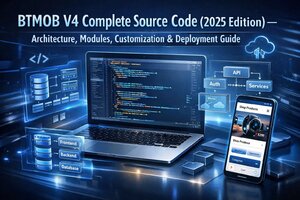
In 2026, software development cycles have accelerated dramatically. Businesses, startups, and independent developers increasingly rely on pre-structured codebases to reduce build time while maintaining scalability and control. One such structured framework gaining attention in development circles is the BTMOB V4 Complete Source Code. Designed as a full-stack mobile-ready system, it provides frontend interfaces, backend logic, database architecture, and administrative control modules in one cohesive package.
A complete source code bundle like BTMOB V4 is not just a template—it represents a structured, deployable ecosystem. For developers looking to customize, scale, or deploy Android-based applications efficiently, understanding the technical framework, architecture design, and integration points becomes essential. This guide explores the system in depth: its structure, modules, deployment model, scalability considerations, and long-term development strategy.
What Is BTMOB V4 Complete Source Code
The BTMOB V4 Complete Source Code refers to a fully packaged mobile application framework that includes both client-side and server-side components. Unlike partial scripts that offer limited UI templates, a complete source package provides core system logic, database handling, authentication layers, administrative panels, and API communication modules.In practical terms, this means developers gain access to every component required to compile, configure, modify, and deploy the application independently. The presence of backend dashboards allows real-time management, while the mobile application source allows user-interface customization. The “V4” version indicates iterative improvements over earlier builds, typically including performance optimization, UI refinements, security updates, and expanded module functionality.
Having full source access gives developers flexibility. They can review code logic, restructure modules, integrate new services, or adjust workflows without relying on external vendors. This level of control is especially valuable in 2026, where digital systems must evolve quickly to remain competitive.
Core Architecture & System Design
The architecture of BTMOB V4 Complete Source Code generally follows a three-tier system design: presentation layer, application logic layer, and data layer. The presentation layer represents the Android mobile interface, responsible for user interactions, forms, dashboards, and display elements.The application logic layer handles core processes such as authentication, transaction workflows, data validation, and API communication. Meanwhile, the data layer connects to structured databases—typically MySQL or similar—where user data, configurations, and system records are stored securely.
Modern frameworks emphasize modularity. BTMOB V4 appears structured in independent modules, allowing developers to isolate features for easier debugging or expansion. Modular architecture enhances maintainability and scalability, making future updates smoother.
Major Components Included in BTMOB V4
Below are the primary structural elements commonly found within BTMOB V4 Complete Source Code:- Android application source files ready for compilation
- Backend administrative control panel
- Database schema with SQL import files
- API communication endpoints for client-server interaction
- Authentication and session management modules
- User account management systems
- Notification management logic
- Configuration scripts and installation guides
The presence of backend management tools is particularly valuable. It allows administrators to manage users, review system logs, adjust configurations, and monitor activity without modifying frontend code.
Deployment & Installation Process (Two Short Paragraphs)
Deploying BTMOB V4 Complete Source Code typically begins with setting up a compatible hosting environment. Developers configure server requirements such as PHP version, database engine, SSL encryption, and required dependencies. After uploading backend files and importing database structures, configuration files must be adjusted to match server credentials and domain details.The Android application is compiled separately using development tools such as Android Studio. API endpoints are linked to the backend server, and environment variables are configured. Once compiled, the application can be tested in staging environments before production release.
Customization & Extensibility
One of the strongest advantages of owning complete source code is unrestricted customization. Developers are not confined to preset workflows. Instead, they can modify design elements, system logic, validation rules, and data structures.For example, UI components can be redesigned to match brand identity. Backend processes can be expanded to include additional modules such as reporting systems, advanced analytics, or third-party API integrations. Because the codebase is accessible, new features can be built directly into the system rather than layered externally.
Extensibility is crucial in 2026. Mobile applications must adapt quickly to regulatory changes, user behavior shifts, and technological advancements. With BTMOB V4’s full access structure, scaling or adapting the system becomes far more manageable.
Security Considerations in Source Code Deployment
Security remains one of the most important factors when deploying any complete source package. Developers should audit authentication flows to ensure password hashing uses strong encryption algorithms and sessions are properly protected.Input validation is equally critical. All user-submitted data must be sanitized to prevent injection attacks. SSL certificates should be installed to secure communication between client and server. Access controls within the administrative dashboard must also be properly configured to prevent unauthorized actions.
Regular patching and dependency updates reduce exposure to vulnerabilities. In 2026, cybersecurity threats evolve rapidly, making proactive maintenance mandatory for safe system operation.
Performance Optimization & Scalability
Modern applications must handle large volumes of traffic without slowing down. BTMOB V4 Complete Source Code can be optimized through database indexing, caching mechanisms, and efficient API handling.High-traffic deployments may benefit from load balancing, content delivery networks (CDNs), and cloud hosting infrastructure. Because the full source is available, developers can fine-tune performance bottlenecks and adjust server configurations according to demand.
Scalability planning ensures the application can support increasing user numbers without compromising speed. Monitoring tools can track resource usage and system response times, allowing proactive scaling adjustments.
Advantages of Using a Complete Source Framework (Bullets Section 2)
Developers choose structured codebases like BTMOB V4 for several technical reasons:- Reduced development time compared to building from scratch
- Full backend control for managing operations
- Editable database structures
- Flexible API integration capabilities
- Improved scalability through modular design
- Lower long-term maintenance costs
- Faster troubleshooting due to structured architecture
Version Control & Development Best Practices (Bullets Section 3)
Managing a complete codebase requires disciplined development practices:- Maintain original backup copies before editing files
- Use Git or version control systems to track changes
- Test updates in staging environments before production
- Document custom modifications for future maintenance
- Review third-party libraries for security vulnerabilities
- Schedule periodic audits for code integrity
Comparison: Full Source Code vs Template Scripts
Template scripts often provide limited flexibility and may restrict backend access. In contrast, BTMOB V4 Complete Source Code offers comprehensive control over system logic and database structures.This difference significantly impacts scalability. With full source code, developers can integrate custom workflows, build new modules, and expand system architecture without structural limitations. Templates, by comparison, often require workarounds that complicate development.
Long-Term Maintenance & Updates
Owning complete source code means ongoing responsibility for maintenance. Developers must update dependencies, monitor security vulnerabilities, and ensure compatibility with newer Android versions.Periodic code reviews help identify inefficiencies or outdated practices. As Android and server environments evolve, maintaining compatibility ensures uninterrupted system performance.
Continuous monitoring tools can detect anomalies in server performance or suspicious activity. Proactive maintenance protects both operational integrity and user trust.
Future Outlook for Mobile Source Frameworks
In 2026 and beyond, mobile systems are expected to incorporate more automation, cloud-native architecture, and API-driven ecosystems. Complete source frameworks like BTMOB V4 are positioned well for adaptation because developers retain full control.Artificial intelligence modules, analytics dashboards, and enhanced data security layers can be integrated into existing codebases. This adaptability ensures long-term relevance in a rapidly evolving technology landscape.
As businesses demand faster deployment cycles and greater customization, full source packages will remain essential tools for developers seeking agility and scalability.
Conclusion
The BTMOB V4 Complete Source Code provides a structured, modular, and fully customizable mobile application framework for developers in 2026. By offering frontend files, backend dashboards, database architecture, and integration-ready APIs, it eliminates the need to build complex systems from scratch.When deployed with proper security practices, version control discipline, and performance optimization strategies, it becomes a powerful foundation for scalable mobile applications. In today’s fast-paced development environment, structured full-source frameworks represent efficiency, flexibility, and long-term control.
FAQs
1. What does “complete source code” mean?It includes all frontend, backend, database, and configuration files required to build and deploy the full application independently.
2. Can BTMOB V4 be customized?
Yes, developers can modify UI elements, backend logic, database structures, and API integrations.
3. What tools are required for deployment?
A compatible web hosting server, database engine, and Android development tools like Android Studio.
4. Is security auditing necessary before going live?
Yes, auditing ensures authentication, data handling, and integrations are secure.
5. Why is version control important?
It prevents data loss, tracks modifications, and simplifies collaborative development.
